


Smart card technology has quietly become the backbone of modern digital finance.
From the EMV chip in your bank card to the NFC antenna powering a tap-to-pay transaction, smart cards are embedded in virtually every secure payment experience happening right now, and the technology has improved more than we can imagine.
From this article, you would get to learn how smart card technology works, EMV becoming the global payment method, NFC changing the Contactless payment experience, and so on.
Related Reads: Tokenomics, gas fee dynamics.
What Is Smart Card Technology?
That circuit is not a passive strip of magnetic data.
It is an active microprocessor and secure memory chip capable of processing information, running cryptographic algorithms, and communicating with a reader either through physical contact or through radio frequency.
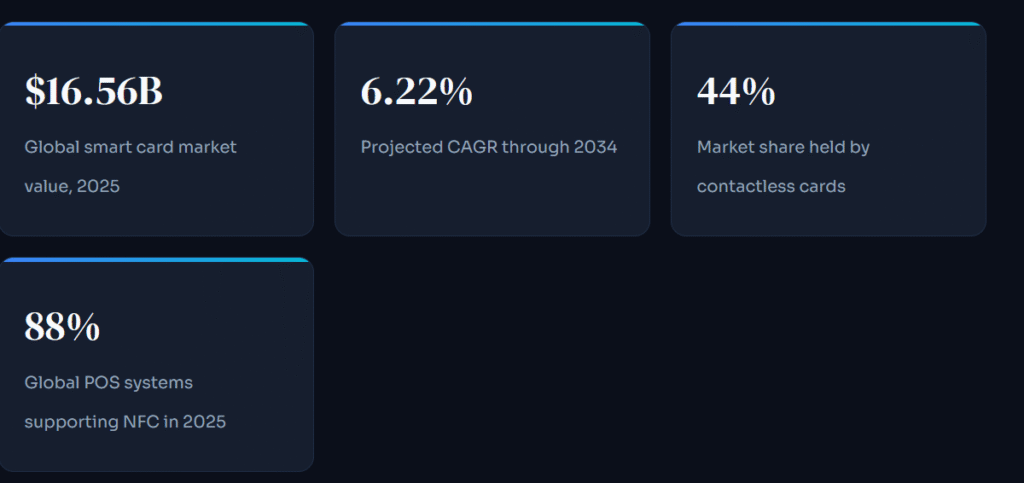
They have become an integral part of our lives, with an estimated 30 to 50 billion smart cards in circulation today.
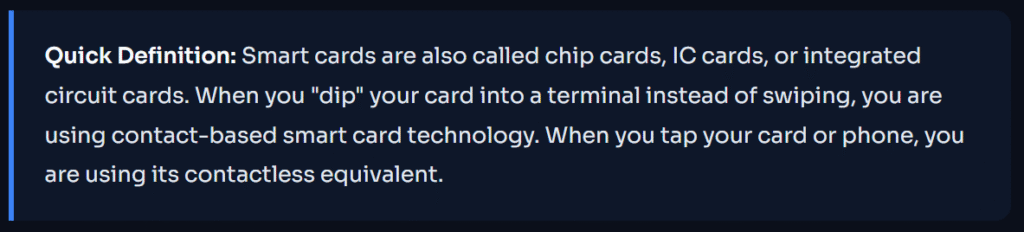
The term smart is well-earned. Unlike older magnetic stripe cards, a smart card stores and processes data within its own secure environment.
Private keys, transaction records, authentication tokens, and even biometric templates can all live inside the card’s tamper-resistant chip, making it dramatically more secure than anything that came before it.
How Does Smart Card Technology Actually Work?
The core component of any smart card is its integrated circuit, which contains a microprocessor (the CPU), ROM for the operating system, EEPROM or Flash memory for user data, and RAM for temporary processing.
When the card interacts with a terminal, this chip performs real-time cryptographic computations to verify identity and authorize transactions.
1. Card Insertion or Tap
The card connects to the reader either through physical contact pads (ISO/IEC 7816) or wirelessly via NFC/RFID (ISO/IEC 14443). Power is supplied to the chip through the reader.
2. Authentication Challenge
The terminal sends a cryptographic challenge to the card. The chip uses its stored private key to generate a unique, one-time response, a signature that cannot be replicated without the key.
3. Transaction Authorization
The signed response is verified by the payment network (Visa, Mastercard, or a crypto gateway).
If valid, the transaction proceeds. The entire exchange takes milliseconds.
4. Confirmation and Receipt
The terminal logs the transaction, the card updates its internal records, and the user receives confirmation. No sensitive data is transmitted in plain text at any stage.
This process is fundamentally different from a magnetic stripe swipe, which simply transmits static account data that can be skimmed and cloned.
A smart card never exposes its private key, it only proves that it has it.
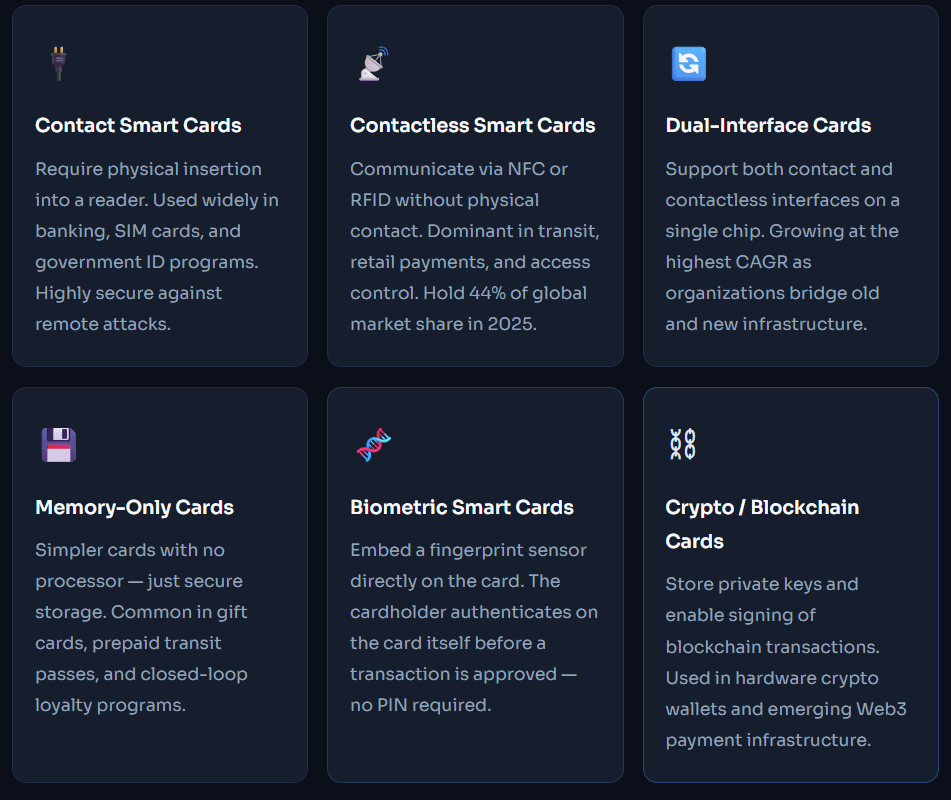
What Are the Different Types of Smart Cards?
Importance of Smart Card Technology in Cryptocurrency Transactions
Smart card technology plays a significant role in enhancing the security and efficiency of crypto transactions. Here are several reasons highlighting the importance of smart card technology in this context:
Secure Storage of Private Keys
Smart cards provide a secure environment for storing private keys, which are crucial for accessing and authorizing crypto transactions.
The tamper-resistant nature of smart cards helps protect these sensitive cryptographic keys from unauthorized access.
Two-Factor Authentication (2FA)
Smart cards often integrate with two-factor authentication mechanisms, adding an extra layer of security to crypto transactions.
Users typically need both their smart card and a PIN to access their crypto wallets or execute transactions, reducing the risk of unauthorized access.
Reduced Risk of Malware and Phishing Attacks
Since smart cards store private keys internally and don’t expose them to external systems, they help mitigate the risk of malware and phishing attacks.
Even if a user’s computer is compromised, the private keys remain secure within the smart card.
Hardware Security Module (HSM) Functionality
Smart cards can function as Hardware Security Modules (HSMs), providing a dedicated and secure environment for cryptographic operations.
This ensures the integrity and confidentiality of the cryptographic processes involved in crypto transactions.
Protection Against Physical Attacks
Smart cards are designed to resist physical attacks, such as tampering or extraction of internal components.
This makes it difficult for attackers to gain physical access to the cryptographic keys stored within the smart card.
Can Smart Cards Support Cryptocurrency and Crypto Wallets?
Yes and this is one of the most exciting intersections in fintech right now.
| Smart Card Type | Crypto Use Case | Supported Assets | Security Model |
| NFC Crypto Card | Tap-to-pay with crypto | BTC, ETH, Stablecoins | Secure element + NFC tokenization |
| Blockchain PKI Card | On-chain transaction signing | Any EVM-compatible chain | Private key never leaves chip |
| Hardware Wallet Card | Cold storage + spending | Multi-chain | Air-gapped key generation |
| Stablecoin Credit Card | Everyday purchases settled in USDC/USDT | USDC, USDT, and regional stablecoins | Custodial + biometric |
For merchants, the key question is whether their payment infrastructure can process crypto transactions from smart cards.
This is where a modern crypto payment gateway becomes essential. UPay’s crypto payment gateway is purpose-built to accept digital asset transactions from wallets, NFC cards, and mobile devices, with automatic conversion options that protect you from volatility.
Why Has EMV Become the Global Payment Standard?
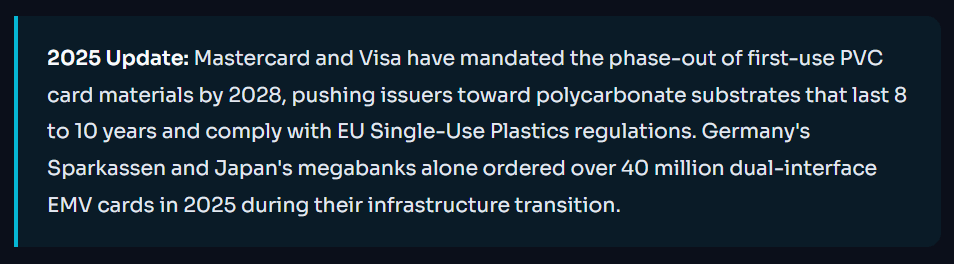
EMV — which stands for Europay, Mastercard, and Visa, it is the international technical standard that governs how smart cards and payment terminals interact.
If you have ever been asked to insert your chip” instead of swiping at a terminal, you have used the EMV standard.
EMV adoption has been one of the most successful fraud-reduction initiatives in financial history.
By replacing static magnetic stripe data with dynamic, cryptographically signed transaction codes, EMV eliminated the most common form of card-present fraud: counterfeit card cloning.
The United States completed its EMV migration nearly a decade ago, and today most card replacement cycles in mature markets are driven by card expiration rather than technology upgrades.
For businesses, EMV compliance is not optional, it is a liability question.
Merchants who do not support EMV chip transactions can be held liable for fraudulent chargebacks under current network rules.
Ensuring your payment gateway supports EMV is as fundamental as having a cash register.
How Is NFC Changing the Contactless Payment Experience?
Near Field Communication (NFC) is the radio technology that makes tap-to-pay possible.
Operating at 13.56 MHz over distances of about 4 centimeters, NFC allows a smart card or an NFC-enabled smartphone to communicate with a payment terminal without any physical contact.
The numbers in 2025 make a compelling case on their own.
Approximately 88% of global point-of-sale systems now support NFC as a standard feature. Canada already records 87% contactless penetration.
Apple Pay, Google Pay, and Samsung Pay have built vast merchant networks where NFC-enabled devices with biometric authentication serve as the primary payment credential for hundreds of millions of people.
What Makes NFC Payments Different from Swiping?
NFC transactions use tokenization. When you tap your card or phone, the terminal never receives your actual account number.
Instead, a unique device-specific token is transmitted one that is worthless to a fraudster because it is tied to a specific device, merchant, and transaction amount.
Combined with biometric unlock on mobile devices, this creates a two-factor authentication flow that is both fast and exceptionally secure.
For businesses, accepting NFC contactless payments is increasingly table stakes not a luxury.
If your point-of-sale system does not support it, you are already creating friction for a growing segment of your customer base.
How Is Blockchain Being Integrated with Smart Card Technology?
Blockchain and smart card technology might seem like different worlds, one is distributed and digital, the other is physical and portable.
But they are increasingly being designed to work together, and the results are striking.
The fundamental connection is the secure element.
A smart card’s chip is essentially a hardware security module in card form a tamper-resistant environment where private keys can be generated and stored without ever being exposed externally.
This makes smart cards a natural physical layer for blockchain identity and transaction signing.
How Do Blockchain-Enabled Smart Cards Work?
A blockchain smart card stores a wallet’s private key within the chip’s secure element.
When a transaction needs to be signed whether on Ethereum, Bitcoin, or another network, the card performs the cryptographic signing internally.
The public key infrastructure (PKI) built into these cards also enables applications beyond payments: secure voting systems, supply chain provenance verification, digital identity for decentralized applications, and cross-border transaction authentication.
Blockchain-powered smart cards can record transaction history on an immutable ledger, improving transparency and auditability across enterprise workflows.
Which Industries Are Being Transformed by Smart Card Technology?
- Banking and Financial Services
- Government and National Identity
- Healthcare
- Transportation and Transit
- Telecommunications
Key Security Features of Smart Card Technology
- Tamper-Resistant Hardware
- Dynamic Authentication
- Secure Element Isolation
- PIN and Biometric Verification
Frequently Asked Questions
What is the difference between a smart card and a regular credit card?
A regular magnetic stripe credit card stores static data, your account number, expiry date, and CVV, that never changes and can be copied.
A smart card contains an active microprocessor chip that performs cryptographic operations in real time.
IS NFC the same as smart card technology?
NFC (Near Field Communication) is a communication protocol, while smart card technology refers to the embedded chip that performs secure processing.
Conclusion
It’s easy to overlook that little piece of plastic in your wallet, but smart card technology is doing a lot of heavy lifting behind the scenes.
As we’ve seen, the shift toward EMV and NFC isn’t just about convenience, it is about building a layer of security that traditional cards simply couldn’t provide.
Feel free to hang out and check out our other resources for a bit, we’ve got plenty on topics such as how to donate crypto to charity, technical analysis in crypto trading, etc, here to help you stay ahead.