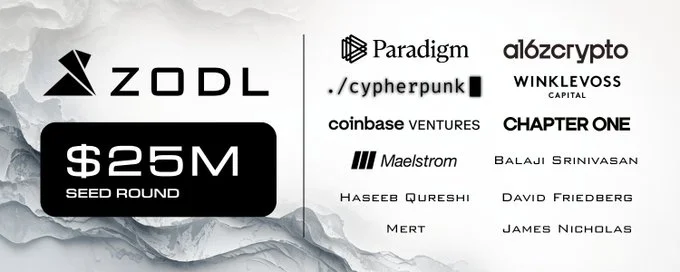
A new development group focused on advancing the Zcash ecosystem has secured more than $25 million in seed funding from some of the most influential investors in the crypto industry.
The organization, called the Zcash Open Development Lab (ZODL), was founded by former members of the Electric Coin Company engineering and product teams following a governance dispute earlier this year.
The funding round drew support from major crypto venture firms, including Paradigm, Andreessen Horowitz’s crypto arm, Coinbase Ventures, and Winklevoss Capital. Other participants included Cypherpunk Holdings, Chapter One, and Maelstrom, alongside a group of high-profile angel investors.
Among the individual backers were Balaji Srinivasan, David Friedberg, and Haseeb Qureshi, reflecting strong investor interest in privacy-focused cryptocurrency infrastructure.
“The funding reflects strong conviction from some of the most respected investors in crypto.”
The capital injection is expected to support engineering hires and accelerate development of tools designed to strengthen the usability and adoption of Zcash.
Key Takeaways
- More than $25 million in seed funding was secured by Zcash Open Development Lab from major crypto investors including Paradigm, Andreessen Horowitz, Coinbase Ventures, and Winklevoss Capital.
- Formation of ZODL followed the resignation of the entire engineering and product team from Electric Coin Company after governance disagreements with the Bootstrap Project.
- Development efforts will focus heavily on the Zodl Wallet, a self-custodial mobile wallet enabling private shielded transactions on the Zcash network.
- Adoption of the wallet has significantly increased privacy activity, expanding Zcash’s shielded pool by over 400% and processing more than $600 million in ZEC swaps since October 2025.
- Market sentiment turned positive after the funding news, with Zcash (ZEC) rising notably as investors reacted to renewed development momentum around the protocol.
A Team Rebuilding After a Governance Rift
ZODL was launched by Josh Swihart, the former chief executive of the Electric Coin Company. Swihart and the entire engineering and product team resigned in January following disagreements with Bootstrap Project, the nonprofit that oversees ECC’s operations.
The dispute centered on governance and the direction of Zcash’s development structure. With the engineering team leaving en masse, the group decided to continue their work independently through the newly formed development lab.
Operationally, the Electric Coin Company remains under the oversight of Bootstrap, but many of the engineers responsible for building core Zcash software are now working within ZODL.
The new entity positions itself as both a protocol maintainer and product developer dedicated to advancing the Zcash ecosystem.
Focus on the Zodl Wallet and Private Transactions
A key focus of ZODL’s development efforts is the Zodl Wallet, a self-custodial mobile wallet designed to support shielded ZEC transactions.
The application was originally released in 2024 under the name Zashi while still part of the Electric Coin Company. After the team’s departure, the wallet was rebranded as Zodl and is now maintained by the new development lab.
Shielded transactions are one of Zcash’s defining features. Using zero-knowledge cryptography, these transfers conceal the sender, receiver, and transaction amount from public view.
“The wallet supports shielded transactions, which hide the sender, receiver, and amount. This is the core privacy feature of the Zcash protocol.”
According to the development team, the wallet has already played a major role in increasing privacy usage on the network.
Since its introduction, activity within Zcash’s shielded pool has grown by more than 400%. The application has also processed over $600 million in ZEC swaps since October 2025, signaling rising demand for private digital payments.
Renewed Momentum for Privacy Infrastructure
The creation of ZODL and the backing from prominent venture firms arrive at a critical time for privacy-focused cryptocurrencies. Regulatory pressure and the delisting of some privacy tokens from exchanges in recent years have challenged projects that emphasize transaction anonymity.
ZODL’s strategy focuses on improving usability rather than solely advancing protocol research. The team believes easier-to-use consumer tools could expand the appeal of private payments.
Part of the funding will go toward expanding the engineering team responsible for Zcash’s core software and building consumer products around the network.
By combining protocol development with wallet infrastructure, the lab hopes to strengthen both liquidity and adoption within the Zcash ecosystem.
Market Reaction to the Announcement
The funding news coincided with a positive move in the price of Zcash’s native token, ZEC.
Following the announcement, the cryptocurrency climbed more than 4% to around $217.80, according to market data. Over a 24-hour period, the token posted gains approaching 10% as broader crypto markets also rebounded.
The rally follows a volatile period for ZEC. Over the past year, the asset surged from roughly $55 to a peak above $500 before retracing alongside the wider market in early 2026.
Investors appear to be interpreting the new funding and the continuity of Zcash’s core engineering talent as a sign of stability for the project’s future development.
What Comes Next for ZODL
With a sizable seed round secured, ZODL now faces the challenge of delivering products that can broaden real-world use of privacy-preserving payments.
The team plans to continue improving the Zodl wallet while contributing to the underlying Zcash protocol. Key areas of development include expanding wallet functionality, strengthening network privacy features, and lowering the technical barriers to using shielded transactions.
If successful, these efforts could reinforce Zcash’s position as one of the most prominent privacy-focused cryptocurrencies.
For now, the funding signals that major investors remain confident in the long-term role of privacy technologies within the crypto industry—and in the team now leading ZODL’s next phase of development.